
Must Hit By
How do Must-Hit-By jackpots work, and when is one worth playing? (2026)
A must-hit-by jackpot has to pay out before its meter reaches a fixed amount, like $500 or $10,000. The closer the meter gets to that cap, the less coin-in is left before it must hit, and the more each spin is worth. EdgeTilt's free Must Hit By calculator turns the meter into an expected value and a play-or-wait verdict.
In short The jackpot must hit before the meter reaches the cap. Near the cap, the remaining coin-in shrinks and the value per spin climbs. Presets for Ainsworth, AGS and IGT, plus Manual for any MHB game. Leave the midpoint switch off when you don't know the game. It's the conservative read.
Most slot jackpots are a mystery box. This one comes with a deadline printed on the glass.
The machine tells you, in plain numbers, the latest point it has to pay by. Your average slot never promises you anything like that. This one does. And that promise is where the math lives.
How does a must-hit-by jackpot work?
Three numbers run the whole show:
- The reset. After the jackpot pays, the meter drops back to this starting value.
- The rise. Every bet feeds a small slice into the meter, so it climbs as people play.
- The must-hit-by point. The cap. The jackpot is guaranteed to hit before the meter reaches it.
Somewhere between the reset and the cap, the jackpot hits. You don't know where. But you do know where it can't go. Past the cap.
Now picture a meter sitting a few dollars under its cap. Only a little coin-in is left before it has to pay, and whoever's in the seat when it does collects the whole thing. The jackpot hasn't shrunk. The price of getting there has.
That's why the math changes as the meter climbs. Early in the range, you're paying full freight for a jackpot that might be a long way off. Near the cap, the same jackpot costs a fraction of the coin-in to chase.
What does the EdgeTilt MHB calculator show?
You give it the meter. It gives you the MHB Analysis:
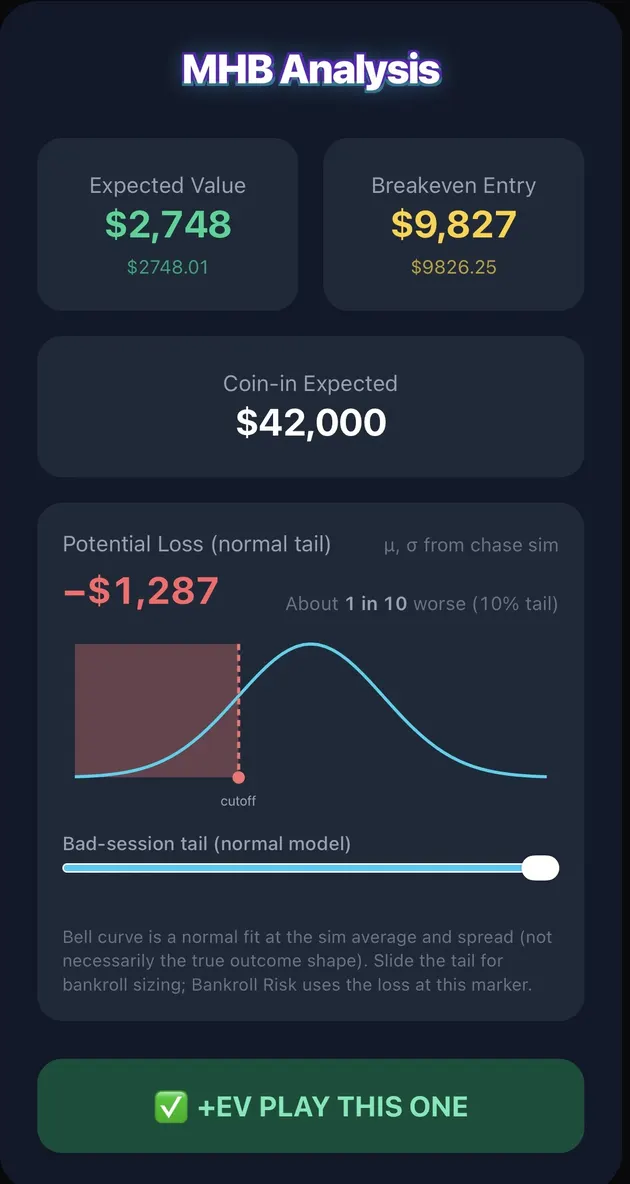
- Expected Value: what the play is worth on average, in dollars. Here, $2,748 ($2748.01).
- Breakeven Entry: the meter reading where the play stops being +EV. Here, $9,827 ($9826.25). The meter is at $9,894.27, so it's past breakeven.
- Coin-in Expected: how much you'd expect to run through the machine before it hits. Here, $42,000.
- Potential Loss (normal tail): a bell curve fitted to the chase simulation, with a Bad-session tail slider. Here, about 1 in 10 sessions does worse than -$1,287. The calculator notes the curve is a normal fit at the sim average and spread, not necessarily the true outcome shape.
- The verdict. Here, +EV PLAY THIS ONE.
The Bankroll Risk card uses the loss at your tail marker to check whether your bankroll can handle the bad version of this play. It reads your bankroll from the Bankroll Manager.
Presets: Ainsworth, AGS and IGT
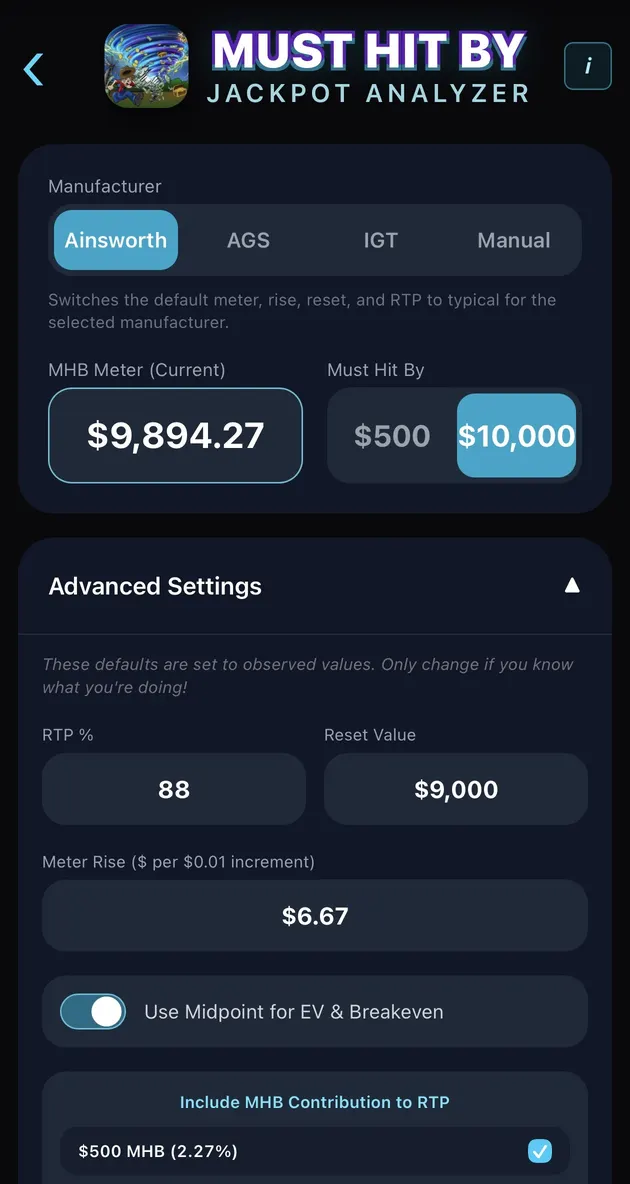
The calculator has presets for Ainsworth, AGS and IGT games. Tap a manufacturer at the top and it loads that maker's typical meter, rise, reset and RTP. The app's own advice on changing them: "Only change if you know what you're doing!"
Here's what the Ainsworth preset loads on a $10,000 must hit by, as shown above:
| Setting | Ainsworth preset |
|---|---|
| RTP % | 88 |
| Reset Value | $9,000 |
| Meter Rise | $6.67 per $0.01 increment |
| Must hit by choices | $500 or $10,000 |
| MHB contribution to RTP | $500 MHB 2.27%, $10,000 MHB 2.85% |
The Include MHB Contribution to RTP checkboxes let you count each must-hit-by level's share of the game's return.
Playing one of these three? Pick the preset, type the meter, done.
Manual mode: any must-hit-by game
Found a must-hit-by from a maker that isn't on the list? Tap Manual. You give the calculator four numbers. Every one of them is something you can check yourself at the machine:
- MHB Meter: the current meter, right off the glass.
- The MHB point: the must-hit-by amount. Usually printed on the machine or the meter display.
- Reset value: what the meter drops back to after it hits. Watch one hit, check the help screens, or ask a regular.
- Meter rise: how much coin-in it takes to move the meter one cent. This is the one you have to measure.
How do you find the meter rise?
The calculator asks for Meter Rise ($ per $0.01 increment): how many dollars of coin-in move the meter up by one cent.
Good news. You can measure it in a few minutes:
- Write down the meter to the cent.
- Play a known amount. Count your spins and multiply by your bet.
- Write down the meter again.
- Divide your coin-in by the number of cents the meter moved.
Example math: if $20.00 of coin-in moves the meter from $9,894.27 to $9,894.30, that's 3 cents. $20.00 ÷ 3 = $6.67 per $0.01, the same number the Ainsworth preset uses.
One tip. Measure over more spins, not fewer. One cent is a tiny step, and a short sample can round badly.
What is the midpoint switch, and when should you use it?
The switch reads Use Midpoint for EV & Breakeven.
Turned on, the calculator bases its EV and breakeven on the midpoint of the jackpot's range. Think of it as the friendlier guess about where the jackpot lands.
Turned off, it assumes the meter can run the full distance. More coin-in, smaller EV, higher breakeven. That's the conservative read.
Use it when you know the game and have good reason to believe its jackpots land around the middle of the range.
Leave it off when you don't know. If you're on an unfamiliar game or in Manual mode with numbers you just measured, the conservative read is the one that won't talk you into a play that isn't there. If a play still reads +EV with the midpoint off, it cleared the stricter test. It's still an estimate.
The decision, in one line
If the MHB Analysis says +EV and Bankroll Risk says your roll can take the bad tail, play it. If either one says no? Keep walking. Either the meter will still be there, or someone else will have paid for it.
Make a free account and open Must Hit By
Keep going
- EdgeTilt slot calculators: how to find +EV slots, and the five free calculators.
- Bankroll Manager: the bankroll Bankroll Risk checks each play against.
- Play Logbook: log the play with one tap and see how your MHB chases add up.
FAQ
Is the Must Hit By calculator free?
Yes. It's one of the five free calculators. You need a free EdgeTilt account.
Which manufacturers does it have presets for?
Ainsworth, AGS and IGT. For any other must-hit-by game, use Manual.
What is meter rise?
The coin-in it takes to move the meter up one cent. The Ainsworth preset uses $6.67 per $0.01.
Should I turn on the midpoint switch?
Only when you know the game well. When you don't, leave it off. It's the more conservative read.
What does Breakeven Entry mean?
The meter reading where the play stops being +EV. Above it, the calculator reads the play as +EV.
Calculator results are estimates, not guarantees. Casinos may restrict advantage play. You must be 21+ to gamble. If gambling stops being fun, call 1-800-GAMBLER.